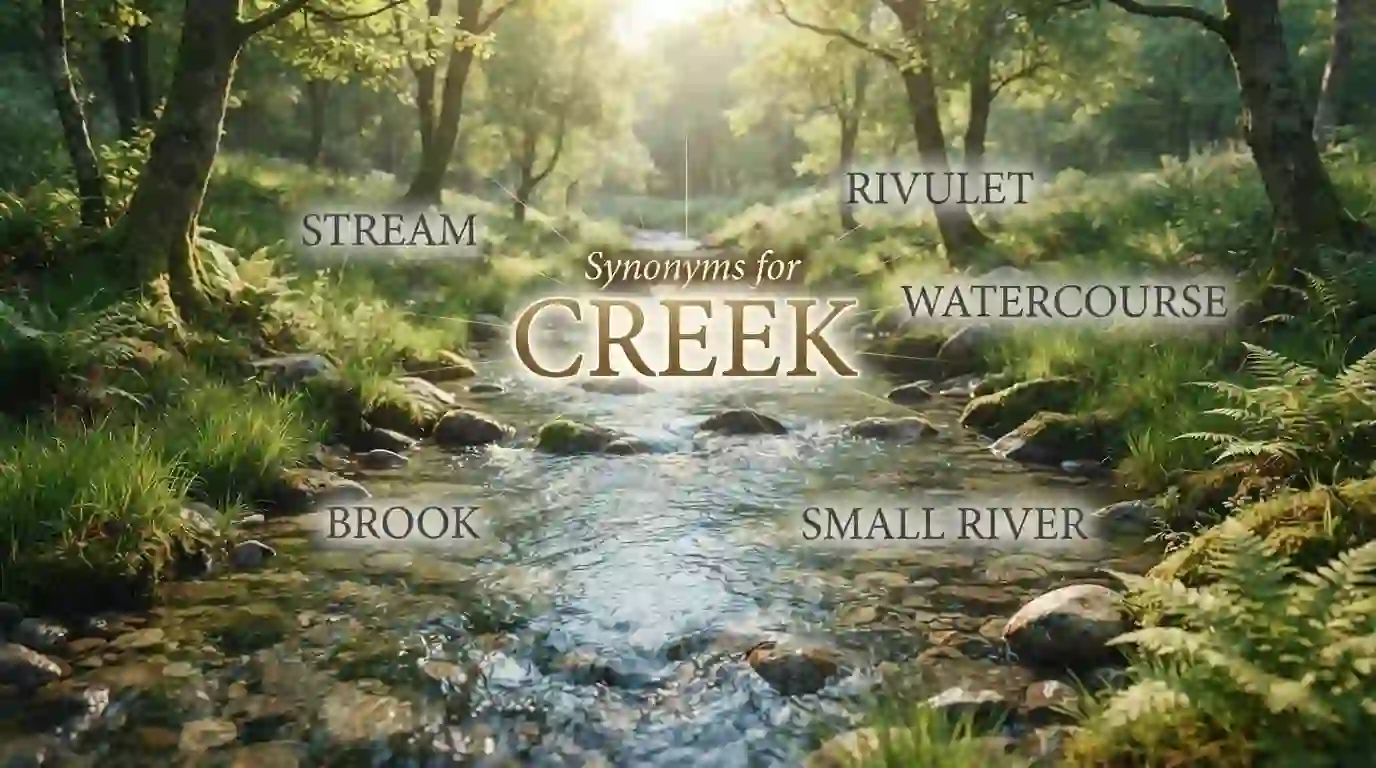
Synonyms for creek help you describe flowing water with vivid details so your writing never feels repetitive or boring.
Imagine walking through a peaceful forest and describing a small stream near your campsite. Calling every body of water a river makes your story feel plain.
Using natural synonyms for creek brings your scenes to life and makes your speech precise. These alternatives expand your active vocabulary quickly.
Mastering these terms is vital for students, bloggers, content writers, and daily English speakers aiming for natural communication.
What Does “Creek” Really Mean?
Creek is a noun that refers to a natural stream of water that is smaller than a river.
Native speakers view it as a calm, flowing body of water found in woods, valleys, or rural towns. It carries a peaceful and gentle tone.
You usually hear it in geographical descriptions, outdoor stories, nature blogging, and everyday conversations.
- Definition: A natural stream of water smaller than a river.
- Part of Speech: Noun
Connotative Meaning
Connotation is the emotional feeling or idea that a word suggests beyond its explicit or literal dictionary definition.
- Positive tone: Peaceful, refreshing, natural, scenic, and relaxing environment.
- Negative tone: Can suggest shallow, muddy, stagnant, or isolated water.
- Neutral tone: A basic geographical term describing a small natural water channel.
Etymology
The word comes from Old Norse kriki and Old French crique, which originally meant a corner, bend, or narrow inlet of the sea.
- Old English (450–1100): Early Germanic and Norse roots referred to narrow inlets or coves along coasts.
- Middle English (1100–1500): Evolved into creke, meaning a narrow tidal inlet or coastal channel.
- Modern English (1500–Present): Shifted in American and Commonwealth English to describe any small inland freshwater stream.
Pronunciation & Structure
- US IPA: /kriːk/ or /krɪk/
- UK IPA: /kriːk/
- Syllables: creek (1 syllable)
- Affixation: Root word: Creek (No prefix or suffix).
Synonyms List
Stream
Stream (Noun) — US: /striːm/ | UK: /striːm/
Meaning: A continuous flow of water moving along a natural channel on earth.
Examples:
- Clear water flowed through the small stream behind our cabin.
- Children love to build small toy boats and float them down the stream.
Brook
Brook (Noun) — US: /brʊk/ | UK: /brʊk/
Meaning: A small and natural stream of freshwater.
Examples:
- The brook babbled softly over the smooth rocks in the quiet woods.
- We sat by the brook to enjoy our afternoon picnic in peace.
Rivulet
Rivulet (Noun) — US: /ˈrɪv.jə.lət/ | UK: /ˈrɪv.jʊ.lət/
Meaning: A very small stream or trickle of liquid.
Examples:
- Rainwater formed a small rivulet down the muddy driveway after the storm.
- A tiny rivulet of cold water trickled down the side of the glacier.
Rill
Rill (Noun) — US: /rɪl/ | UK: /rɪl/
Meaning: A shallow and very narrow channel of water.
Examples:
- Sunlight sparkled on the thin rill cutting through the grassy field.
- A tiny rill flowed gently down the steep hillside after the morning shower.
Runnel
Runnel (Noun) — US: /ˈrʌn.əl/ | UK: /ˈrʌn.əl/
Meaning: A narrow channel or small stream for liquid to run along.
Examples:
- Water ran quickly down the concrete runnel during the sudden downpour.
- The gardener dug a runnel to guide water straight to the flower beds.
Tributary
Tributary (Noun) — US: /ˈtrɪb.jə.ter.i/ | UK: /ˈtrɪb.jə.tər.i/
Meaning: A freshwater stream or river that flows into a larger river or lake.
Examples:
- The small tributary joins the main river just outside the mountain town.
- Scientists studied pollution levels in every minor tributary along the valley.
Branch
Branch (Noun) — US: /bræntʃ/ | UK: /brɑːntʃ/
Meaning: A secondary stream or water channel that flows into a larger stream.
Examples:
- They set up their campsite near the north branch of the main stream.
- The river divides into a small branch near the farmland border.
Watercourse
Watercourse (Noun) — US: /ˈwɑː.t̬ɚ.kɔːrs/ | UK: /ˈwɔː.tə.kɔːs/
Meaning: A natural or artificial channel through which water flows continuously.
Examples:
- Maps showed an ancient watercourse running through the center of the valley.
- Local laws protect the natural watercourse from industrial waste dumping.
Inlet
Inlet (Noun) — US: /ˈɪn.let/ | UK: /ˈɪn.lət/
Meaning: A narrow strip of water leading inland from a coast or lake.
Examples:
- Fishermen anchored their small wooden boats in the quiet coastal inlet.
- We explored the rocky inlet using kayaks during our beach vacation.
Run
Run (Noun) — US: /rʌn/ | UK: /rʌn/
Meaning: A small fast-flowing stream or water channel.
Examples:
- The locals caught fresh trout in the cold mountain run.
- A shallow run flows directly past the old wooden barn.
Burn
Burn (Noun) — US: /bɝːn/ | UK: /bɜːn/
Meaning: A small stream or brook found mainly in Scottish or Northern English geography.
Examples:
- We walked alongside a clear mountain burn during our trip to Scotland.
- Sheep gathered near the edge of the rocky burn to drink water.
Beck
Beck (Noun) — US: /bek/ | UK: /bek/
Meaning: A small stream with a stony bed, common in Northern England.
Examples:
- Cold water splashed over smooth grey stones in the village beck.
- A narrow wooden bridge crosses the beck near the historic church.
Channel
Channel (Noun) — US: /ˈtʃæn.əl/ | UK: /ˈtʃæn.əl/
Meaning: A wide bed where water flows or connects two larger bodies of water.
Examples:
- Deep water moves swiftly through the main navigation channel.
- Heavy rainfall created a new water channel through the open field.
Canal
Canal (Noun) — US: /kəˈnæl/ | UK: /kəˈnæl/
Meaning: An artificial waterway built to allow boats to travel or to carry water.
Examples:
- Barges moved slowly down the historic canal in the center of town.
- Farmers dug an irrigation canal to carry river water to crop fields.
Gully
Gully (Noun) — US: /ˈɡʌl.i/ | UK: /ˈɡʌl.i/
Meaning: A ravine or ditch formed by water washing away the soil.
Examples:
- Rainwater collected in the deep gully at the bottom of the dirt road.
- Hikers stepped carefully across the dry gully during their desert trek.
Waterway
Waterway (Noun) — US: /ˈwɑː.t̬ɚ.weɪ/ | UK: /ˈwɔː.tə.weɪ/
Meaning: A river, canal, or other body of water that boats can travel on.
Examples:
- The local waterway remains a busy route for freight transport and tours.
- Environmental groups work hard to clean trash from the city waterway.
Spillway
Spillway (Noun) — US: /ˈspɪl.weɪ/ | UK: /ˈspɪl.weɪ/
Meaning: A passage or channel designed for overflow water from a dam or reservoir.
Examples:
- Engineers opened the dam spillway to release excess floodwater safely.
- Foam formed as rushing water poured rapidly down the concrete spillway.
Freshet
Freshet (Noun) — US: /ˈfreʃ.ɪt/ | UK: /ˈfreʃ.ɪt/
Meaning: A sudden overflow of a stream caused by heavy rain or melting snow.
Examples:
- Spring warmth caused a heavy freshet that filled the dry stream beds.
- The seasonal freshet washed away small wooden paths along the riverbank.
Ditch
Ditch (Noun) — US: /dɪtʃ/ | UK: /dɪtʃ/
Meaning: A narrow channel dug in the ground to drain away excess water.
Examples:
- Rainwater filled the drainage ditch alongside the country highway.
- The farmer cleared leaves out of the irrigation ditch before planting.
Bayou
Bayou (Noun) — US: /ˈbaɪ.uː/ | UK: /ˈbaɪ.uː/
Meaning: A marshy arm or outlet of a lake or river found in Southern regions.
Examples:
- Alligators swam slowly through the quiet waters of the southern bayou.
- Tour boats navigated through the thick trees filling the flooded bayou.
Slough
Slough (Noun) — US: /sluː/ | UK: /slaʊ/
Meaning: A swamp, bog, or side channel filled with deep mud and slow water.
Examples:
- Wild ducks nested safely among the tall reeds growing in the quiet slough.
- The muddy paths around the slough made hiking difficult after the rain.
Estuary
Estuary (Noun) — US: /ˈes.tʃu.er.i/ | UK: /ˈes.tʃu.ər.i/
Meaning: The wide mouth of a river where fresh water meets ocean tides.
Examples:
- Many species of birds gather to feed along the muddy coastal estuary.
- Salty ocean tides mix with river water inside the wide estuary channel.
Streamlet
Streamlet (Noun) — US: /ˈstriːm.lət/ | UK: /ˈstriːm.lət/
Meaning: A very small or minor stream of water.
Examples:
- A clear streamlet wound its way through the mossy rocks in the canyon.
- We followed a tiny streamlet to find the hidden mountain waterfall.
Feeder
Feeder (Noun) — US: /ˈfiː.dɚ/ | UK: /ˈfiː.də/
Meaning: A tributary stream that supplies water to a larger river, lake, or pond.
Examples:
- The mountain lake receives freshwater from a small feeder on its north side.
- Pollution in the feeder stream harmed fish in the larger reservoir below.
Headwater
Headwater (Noun) — US: /ˈhed.wɑː.t̬ɚ/ | UK: /ˈhed.wɔː.tə/
Meaning: The streams or brooks that form the source of a larger river.
Examples:
- Conservation efforts focus on protecting the clean mountain headwater zone.
- The river begins as a tiny headwater trickling out of cold limestone rocks.
Millstream
Millstream (Noun) — US: /ˈmɪl.striːm/ | UK: /ˈmɪl.striːm/
Meaning: A stream of water used to turn a water wheel for a mill.
Examples:
- The historic wooden wheel turned steadily in the rushing millstream.
- Tourists gathered near the ancient millstream to take colorful photos.
Arroyo
Arroyo (Noun) — US: /əˈroɪ.oʊ/ | UK: /əˈrɔɪ.əʊ/
Meaning: A dry gully or water channel that fills quickly after heavy rain.
Examples:
- Flash floods filled the desert arroyo within a few short minutes.
- Hikers avoided camping inside the low arroyo during monsoon season.
Wash
Wash (Noun) — US: /wɑːʃ/ | UK: /wɒʃ/
Meaning: The dry bed of a stream that fills with water only after rare rainstorms.
Examples:
- The desert road crosses a wide sandy wash that floods in heavy rain.
- Rocks washed down the dry wash during the sudden desert thunderstorm.
Firth
Firth (Noun) — US: /fɝːθ/ | UK: /fɜːθ/
Meaning: A long narrow inlet of the sea or a large river mouth in coastal areas.
Examples:
- Ships anchored safely in the calm waters of the coastal Scottish firth.
- The sun set peacefully over the wide firth near the northern harbor.
Channelway
Channelway (Noun) — US: /ˈtʃæn.əl.weɪ/ | UK: /ˈtʃæn.əl.weɪ/
Meaning: An open path or natural structure that directs the flow of moving water.
Examples:
- Rocks lined the deep channelway to prevent soil erosion near the road.
- The strong current created a clear channelway through the marshland.
Gut
Gut (Noun) — US: /ɡʌt/ | UK: /ɡʌt/
Meaning: A narrow channel, stream, or gully carrying a swift current of water.
Examples:
- Fishermen guided their small skiff carefully through the narrow tidal gut.
- Water rushed through the rocky gut after the high tide rolled in.
Kill
Kill (Noun) — US: /kɪl/ | UK: /kɪl/
Meaning: A stream or creek channel, used commonly in Dutch-influenced regions of New York.
Examples:
- The early settlers built a trading post right alongside the freshwater kill.
- We hiked along the banks of the historic mountain kill all afternoon.
Swale
Swale (Noun) — US: /sweɪl/ | UK: /sweɪl/
Meaning: A low, shallow tract of land that collects and directs water runoff.
Examples:
- Rainwater pooled gently in the grassy swale between the two park hills.
- Landscapers designed a vegetated swale to absorb excess water from the parking lot.
Race
Race (Noun) — US: /reɪs/ | UK: /reɪs/
Meaning: A strong, fast current of water or an artificial channel leading water to a wheel.
Examples:
- The rushing water created a dangerous race near the old wooden dam.
- Engineers adjusted the gate to control the water flowing into the factory race.
Sluice
Sluice (Noun) — US: /sluːs/ | UK: /sluːs/
Meaning: A sliding gate or artificial channel used for controlling the flow of water.
Examples:
- Miners poured river water through the wooden sluice to wash away mud.
- Workers opened the sluice to drain the overflow from the heavy rain.
Reach
Reach (Noun) — US: /riːts/ | UK: /riːts/
Meaning: A continuous, straight stretch of water between two bends in a stream.
Examples:
- Rowers glided smoothly along the calm reach of the local stream.
- The long reach offered clear visibility for boats traveling downstream.
Backwater
Backwater (Noun) — US: /ˈbæk.wɑː.t̬ɚ/ | UK: /ˈbæk.wɔː.tə/
Meaning: A peaceful part of a river or stream untouched by the main current.
Examples:
- Paddlers guided their canoes into a quiet backwater to watch the birds.
- Fallen leaves floated motionless on the surface of the shaded backwater.
Coulee
Coulee (Noun) — US: /ˈkuː.li/ | UK: /ˈkuː.li/
Meaning: A ravine or shallow water channel that is often dry in summertime.
Examples:
- Wild grass grew tall along the bottom of the dry western coulee.
- Spring snowmelt filled the coulee with a rushing stream for a few weeks.
Sough
Sough (Noun) — US: /saʊ/ or /sʌf/ | UK: /saʊ/ or /sʌf/
Meaning: A small drain, watercourse, or marshy channel that carries away moisture.
Examples:
- Excess water trickled down the ancient stone sough behind the farmhouse.
- The field stayed dry thanks to the deep drainage sough along the fence.
Fleam
Fleam (Noun) — US: /fliːm/ | UK: /fliːm/
Meaning: A artificial water channel cut to divert water from a main stream.
Examples:
- The old fleam directed water straight from the brook to the village pond.
- Water level dropped in the fleam once the main floodgates were closed.
Synonyms for Creek by Tone
Selecting the right term depends heavily on context and audience expectations. Tone shapes how readers visualize nature scenes in writing.
Positive Tone
Terms that evoke beauty, peace, and scenic outdoor environments.
- Brook: Suggests a gentle, pleasant, and musical water flow.
- Streamlet: Highlights a tiny, charming, and peaceful body of water.
- Rivulet: Creates pictures of clean, clear, and delicate water movement.
Neutral Tone
Factual terms useful for science, maps, news, and academic writing.
- Stream: The standard, plain term for any moving water body.
- Watercourse: Official word used in geographic and environmental reports.
- Tributary: Precise term for streams entering bigger bodies of water.
Negative / Harsh Tone
Words used when water channels are muddy, dangerous, or dirty.
- Ditch: Suggests artificial drainage, standing water, or dirt roads.
- Slough: Implies muddy, swampy, stagnant, or unpleasant conditions.
- Gully: Associated with soil erosion, sudden floods, and broken ground.
Informal / Regional Tone
Words used in specific cultures or casual conversations.
- Beck: Traditional term in Northern England for rocky streams.
- Burn: Scottish word used casually for countryside brooks.
- Kill: Dutch-origin regional word used in parts of the eastern United States.
Mini Comparison:
Choosing the right word keeps your descriptions clear and geographically accurate.
Creek vs Brook
- Meaning Difference: A creek is generally larger than a brook. A brook is typically shallow enough to step over easily.
- Tone Difference: Creek is a standard everyday word. Brook sounds poetic, peaceful, and descriptive.
- When to Use: Use creek for general geographical descriptions. Use brook for creative writing and nature scenes.
Creek vs Stream
- Meaning Difference: Stream is a broad term for any moving water. A creek is a specific type of small-to-medium stream.
- Tone Difference: Stream is completely neutral. Creek feels regional, grounded, and rustic.
- When to Use: Use stream in academic or general contexts. Use creek when setting rural or forest story settings.
How “Creek” Changes by Context
- Daily Conversation: Native speakers say creek, stream, or ditch when chatting casually about outdoor places (e.g., “The kids played near the creek”).
- Writing & Blogging: Nature bloggers prefer descriptive options like brook, rivulet, or waterway to engage readers visually.
- Professional & Academic Tone: Scientists and researchers rely on tributary, watercourse, or headwater for formal reports.
- Creative Writing: Novelists use atmospheric terms like beck, burn, slough, coulee, or arroyo to build specific geographic settings.
Common Mistakes & Native Usage
Misuse Scenarios
- Confusing Creek with River: A river is large and navigable for commercial ships. Calling a large river a creek sounds inaccurate.
- Using Ditch for Natural Streams: A ditch is usually dug by humans for drainage. Do not use it for scenic forest streams.
- Mispronouncing Creek: While some US regions say “krik,” the standard international pronunciation is “kreek.”
Register Notes
- Formal vs Informal: Watercourse and tributary belong in formal writing. Run and ditch fit informal, casual settings.
- Spoken vs Written: Words like rivulet and freshet appear often in literature but rarely in daily spoken conversations.
(Tip: Expanding your vocabulary with semantic variations helps build strong, professional English communication skills.)
Real-Life Mini Scenarios
- Workplace: Environmental engineers measure water quality in a mountain tributary before building a new reservoir.
- Social Situations: Friends set up their picnic blanket near a quiet brook during a weekend hiking trip.
- Media & Pop Culture: Travel documentaries highlight unique wildlife living along the tropical bayou.
- Writing & Storytelling: An author describes rain forming a tiny rivulet down the windowpane to show sadness.
Interactive Practice Exercise
Test your knowledge of these terms with these multiple-choice questions!
- Which synonym sounds most poetic and describes a very small, gentle stream?
a) Ditch
b) Brook
c) Spillway
d) Canal - A freshwater stream that flows directly into a larger river is called a:
a) Tributary
b) Gully
c) Arroyo
d) Slough - Which term is an artificial waterway constructed for boats or irrigation?
a) Beck
b) Canal
c) Burn
d) Rivulet - If a desert channel suddenly fills with water during heavy rain, it is an:
a) Inlet
b) Arroyo
c) Estuary
d) Millstream - What is the main difference between a river and a creek?
a) A creek is much larger than a river
b) A river is much larger than a creek
c) Rivers are always artificial
d) Creeks only contain saltwater - Which word is used in Scotland for a small countryside stream?
a) Burn
b) Wash
c) Slough
d) Gully - Choose the formal, academic term used in scientific geography reports:
a) Runnel
b) Ditch
c) Watercourse
d) Beck - Where a freshwater river meets the ocean tide, that water area is called an:
a) Estuary
b) Arroyo
c) Rill
d) Spillway - Which word carries a negative tone, suggesting muddy or standing water?
a) Brook
b) Slough
c) Streamlet
d) Rivulet - A very thin trickle of water running down a rock face is best called a:
a) Waterway
b) Canal
c) Rivulet
d) Firth
Reflection Task
Write one original sentence describing a natural landscape using the word brook or tributary.
ansr key laiin ma lekh do sedhii: 1-b, 2-a, 3-b, 4-b, 5-b, 6-a, 7-c, 8-a, 9-b, 10-c
Conclusion
Learning synonyms for creek gives you the exact words needed to paint clear, vivid pictures in your writing and speaking.
When you understand how water terms change by size and regional context, your English communication becomes precise and engaging.
Try using two new water synonyms from this guide in your next story, essay, or email to practice naturally.
Building a strong vocabulary step by step boosts your confidence in everyday speech, blogging, and professional writing.

Evelyn Hartwell is an English vocabulary writer who focuses on clear, practical language for learners and everyday readers. Her writing explores synonyms, word meanings, pronunciation, tone, and natural usage. She believes that learning vocabulary should be simple, useful, and enjoyable. Her articles are designed to help students, bloggers, and English learners choose the right words with greater confidence.