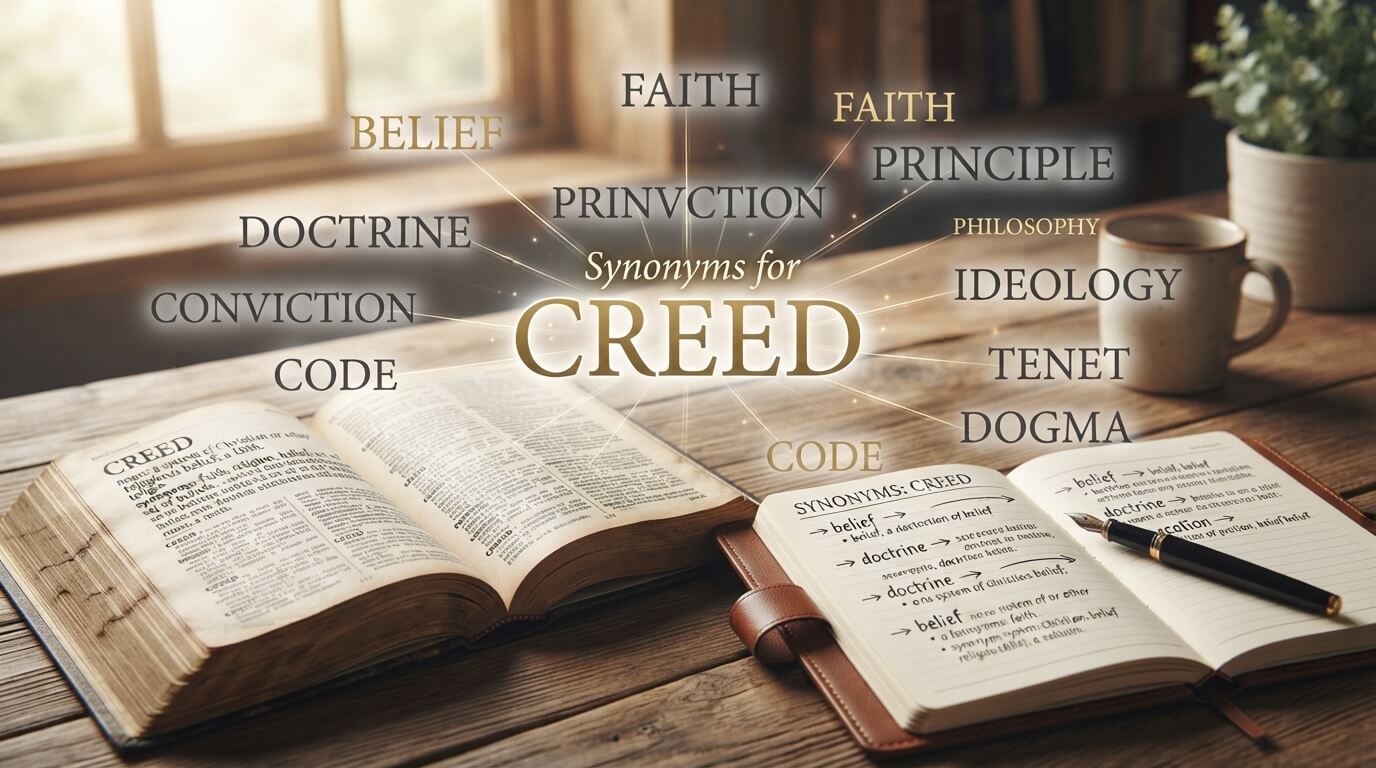
Synonyms for creed help you express your deepest beliefs, core values, and guiding principles without repeating the same word in your writing.
Imagine sitting in an interview and explaining the core philosophy that drives your work ethic. Saying “my belief” repeatedly can sound simple and plain.
Using strong synonyms for creed makes your conversation rich, precise, and highly engaging. Students, bloggers, content writers, and daily English users need variety.
Mastering these words elevates your communication and makes your essays, blog posts, and daily discussions far more natural and persuasive.
What Does “Creed” Really Mean?
Creed (noun) means a set of fundamental beliefs, principles, or opinions that guide a person’s or group’s actions and decisions.
Native speakers understand it as a deeply held set of core values. It often carries a formal, noble, or serious emotional tone.
You will commonly hear it in religious, corporate, personal, or philosophical contexts.
- Definition: A statement or system of accepted beliefs or principles.
- Part of Speech: Noun
Connotative Meaning
Connotation is the emotional feeling or idea that a word suggests beyond its literal dictionary definition.
- Positive tone: Represents integrity, unity, guidance, and strong moral grounding.
- Negative tone: Can imply stubbornness or dogmatic thinking if followed blindly.
- Neutral tone: Simply refers to an official statement of beliefs or a code.
Etymology
The word “creed” comes from the Latin word credo, which means “I believe.”
- Old English (450–1100): Borrowed as creda from Latin, strictly used in religious prayers.
- Middle English (1100–1500): Evolved into crede, expanding beyond church recitations into broader moral promises.
- Modern English (1500–Present): Became “creed,” covering personal convictions, organizational missions, and secular philosophies.
Pronunciation & Structure
- US IPA: /kriːd/
- UK IPA: /kriːd/
- Syllables: creed (1 syllable)
- Affixation: Root word: Creed (No active prefix or suffix).
Synonyms for Creed
Belief
Belief (Noun) — US: /bɪˈliːf/ | UK: /bɪˈliːf/
Meaning: An acceptance that something is true or exists without needing physical proof.
Examples:
- Her belief in hard work helped her start a successful business.
- He stayed true to his personal belief despite outside pressure.
Doctrine
Doctrine (Noun) — US: /ˈdɑːk.trɪn/ | UK: /ˈdɒk.trɪn/
Meaning: A set of beliefs taught and accepted by a church, political party, or official group.
Examples:
- The company follows a strict doctrine of honesty and customer transparency.
- They studied the ancient political doctrine during their college history class.
Faith
Faith (Noun) — US: /feɪθ/ | UK: /feɪθ/
Meaning: Complete trust or confidence in someone, something, or a set of spiritual beliefs.
Examples:
- Her faith guided her through the hardest moments of her life.
- The team had absolute faith in their leader’s vision.
Dogma
Dogma (Noun) — US: /ˈdɔːɡ.mə/ | UK: /ˈdɒɡ.mə/
Meaning: A principle or set of principles laid down by an authority as incontrovertibly true.
Examples:
- The young scientist questioned the traditional dogma of the research team.
- He refuses to follow blind dogma without seeing real evidence first.
Code
Code (Noun) — US: /koʊd/ | UK: /kəʊd/
Meaning: A set of rules or principles accepted by a group or individual for behavior.
Examples:
- The soldiers followed a strict moral code during their mission.
- Integrity is the foundational code of our company culture.
Tenet
Tenet (Noun) — US: /ˈten.ət/ | UK: /ˈten.ɪt/
Meaning: A principle or belief held to be true by a group or organization.
Examples:
- Freedom of speech is a main tenet of a healthy democracy.
- Kindness is the central tenet of her personal life.
Philosophy
Philosophy (Noun) — US: /fɪˈlɑː.sə.fi/ | UK: /fɪˈlɒs.ə.fi/
Meaning: A theory or attitude that acts as a guiding principle for behavior.
Examples:
- Our business philosophy focuses on quality rather than fast sales.
- He lives by a simple philosophy of doing good every day.
Conviction
Conviction (Noun) — US: /kənˈvɪk.ʃən/ | UK: /kənˈvɪk.ʃən/
Meaning: A firmly held belief or opinion that does not change easily.
Examples:
- She spoke about environmental protection with deep conviction.
- It takes real conviction to stand up for your ideas alone.
Motto
Motto (Noun) — US: /ˈmɑː.toʊ/ | UK: /ˈmɒt.əʊ/
Meaning: A short sentence or phrase chosen as encapsulating the beliefs or ideals of an entity.
Examples:
- “Work hard and stay humble” is the athlete’s personal motto.
- The school motto encourages every student to aim high.
Manifesto
Manifesto (Noun) — US: /ˌmæn.əˈfes.toʊ/ | UK: /ˌmæn.ɪˈfes.təʊ/
Meaning: A public declaration of policy, aims, and underlying beliefs issued by a group.
Examples:
- The political party released its new economic manifesto today.
- The artist wrote a creative manifesto outlining his vision.
Ideology
Ideology (Noun) — US: /ˌaɪ.diˈɑː.lə.dʒi/ | UK: /ˌaɪ.diˈɒl.ə.dʒi/
Meaning: A system of ideas and ideals that forms the basis of economic or political policy.
Examples:
- The two nations struggled to communicate due to differing political ideologies.
- She prefers practical solutions over strict ideological thinking.
Persuasion
Persuasion (Noun) — US: /pɚˈsweɪ.ʒən/ | UK: /pəˈsweɪ.ʒən/
Meaning: A particular system of religious or political beliefs.
Examples:
- People of every religious persuasion joined the community walk.
- Writers of all political persuasions attended the open conference.
Canon
Canon (Noun) — US: /ˈkæn.ən/ | UK: /ˈkæn.ən/
Meaning: A general law, rule, principle, or criterion by which something is judged.
Examples:
- Honesty is an essential canon of good journalism.
- The artwork broke every accepted canon of traditional painting.
Credo
Credo (Noun) — US: /ˈkriː.doʊ/ | UK: /ˈkriː.dəʊ/
Meaning: A statement of the beliefs or aims that guide someone’s actions.
Examples:
- Customer satisfaction remains the core credo of our brand.
- His personal credo is to leave every place better than he found it.
Ethics
Ethics (Noun) — US: /ˈeθ.ɪks/ | UK: /ˈeθ.ɪks/
Meaning: Moral principles that govern a person’s behavior or the conducting of an activity.
Examples:
- The journalist maintained high professional ethics throughout the story.
- Strong work ethics will always lead to long-term success.
Principles
Principles (Noun) — US: /ˈprɪn.sə.pəlz/ | UK: /ˈprɪn.sə.pəlz/
Meaning: Fundamental truths or rules that serve as the foundation for a system of belief.
Examples:
- She refuses to compromise her core principles for money.
- The treaty was built on principles of mutual respect and peace.
Gospel
Gospel (Noun) — US: /ˈɡɑː.spəl/ | UK: /ˈɡɒs.pəl/
Meaning: A set of principles or a guide that one accepts as completely true.
Examples:
- Beginners often take the manager’s words as absolute gospel.
- You should not treat every article on the internet as gospel.
Values
Values (Noun) — US: /ˈvæl.juːz/ | UK: /ˈvæl.juːz/
Meaning: A person’s principles or standards of behavior regarding what is important in life.
Examples:
- Family values play a central role in shaping a child’s character.
- The company rewards employees who demonstrate its core values.
Axiom
Axiom (Noun) — US: /ˈæk.si.əm/ | UK: /ˈæk.si.əm/
Meaning: A statement or proposition that is regarded as being established, accepted, or self-evidently true.
Examples:
- It is an accepted axiom that practice improves performance over time.
- The financial strategy rests on a simple economic axiom.
Stance
Stance (Noun) — US: /stæns/ | UK: /stɑːns/
Meaning: An attitude or position taken toward an issue or belief system.
Examples:
- The government took a strong stance against environmental pollution.
- Her stance on education reform gained wide public support.
Rule
Rule (Noun) — US: /ruːl/ | UK: /ruːl/
Meaning: An accepted principle or instruction that states the way things should be done.
Examples:
- Treating others fairly is an unwritten rule in our office.
- He strictly follows the rule of checking every detail twice.
Standard
Standard (Noun) — US: /ˈstæn.dɚd/ | UK: /ˈstæn.dəd/
Meaning: A moral principle or level of quality that is accepted as a norm.
Examples:
- High moral standards define the core culture of this school.
- She maintained her editorial standard even under tight deadlines.
Worldview
Worldview (Noun) — US: /ˈwɝːld.vjuː/ | UK: /ˈwɜːld.vjuː/
Meaning: A comprehensive concept or framework of the world and human life.
Examples:
- Living abroad completely transformed her personal worldview.
- Their shared worldview brought the two researchers together.
Precept
Precept (Noun) — US: /ˈpriː.sept/ | UK: /ˈpriː.sept/
Meaning: A general rule intended to regulate behavior or thought.
Examples:
- He lived according to the basic precepts of justice and charity.
- She learned important moral precepts from her grandparents.
Article of Faith
Article of Faith (Noun) — US: /ˈɑːr.t̬ɪ.kəl əv feɪθ/ | UK: /ˈɑː.tɪ.kəl əv feɪθ/
Meaning: A central belief that is accepted as unquestionably true by a group.
Examples:
- Equal opportunity is a fundamental article of faith in our company.
- Honesty remains an essential article of faith for their team.
Catechism
Catechism (Noun) — US: /ˈkæt̬.ə.kɪ.zəm/ | UK: /ˈkæt.ə.kɪ.zəm/
Meaning: A summary or series of basic principles and beliefs taught to a group.
Examples:
- The students studied the foundational catechism during their ethics class.
- He wrote a short business catechism to guide new employees.
Platform
Platform (Noun) — US: /ˈplæt.fɔːrm/ | UK: /ˈplæt.fɔːm/
Meaning: A declared set of principles and goals put forward by a group or candidate.
Examples:
- The politician ran on a platform of economic reform and education funding.
- Environmental safety was the central issue of their party platform.
Position
Position (Noun) — US: /pəˈzɪʃ.ən/ | UK: /pəˈzɪʃ.ən/
Meaning: An opinion or stance on a particular issue held by an individual or group.
Examples:
- The board made its official position clear in a public statement.
- She took a firm position on protecting consumer rights.
Ideal
Ideal (Noun) — US: /aɪˈdiː.əl/ | UK: /aɪˈdɪəl/
Meaning: A principle or standard of perfection that one strives to achieve.
Examples:
- They fought bravely to uphold their democratic ideals.
- Kindness and hard work were the highest ideals in his family.
Commitment
Commitment (Noun) — US: /kəˈmɪt.mənt/ | UK: /kəˈmɪt.mənt/
Meaning: A strong dedication to a cause, belief, or course of action.
Examples:
- Her commitment to social justice inspired everyone around her.
- The team renewed its commitment to excellent customer service.
Confession
Confession (Noun) — US: /kənˈfeʃ.ən/ | UK: /kənˈfeʃ.ən/
Meaning: A formal statement of religious or philosophical beliefs held by a group.
Examples:
- The church drafted a new confession of faith during the conference.
- Their shared confession united communities across the nation.
Mindset
Mindset (Noun) — US: /ˈmaɪnd.set/ | UK: /ˈmaɪnd.set/
Meaning: An established set of attitudes or beliefs held by someone.
Examples:
- Adopting a growth mindset helped him overcome failure.
- Her positive mindset allowed her to handle challenging projects.
Policy
Policy (Noun) — US: /ˈpɑː.lə.si/ | UK: /ˈpɒl.ə.si/
Meaning: A course or principle of action adopted or proposed by an organization or individual.
Examples:
- Honesty is the best policy when communicating with clients.
- The company introduced a strict policy against workplace harassment.
Ethos
Ethos (Noun) — US: /ˈiː.θɑːs/ | UK: /ˈiː.θɒs/
Meaning: The characteristic spirit, belief, or culture of a community or organization.
Examples:
- Innovation and creativity define the core ethos of Silicon Valley.
- The school’s ethos emphasizes collaboration over competition.
Persuasion System
Persuasion System (Noun) — US: /pɚˈsweɪ.ʒən ˈsɪs.təm/ | UK: /pəˈsweɪ.ʒən ˈsɪs.təm/
Meaning: An organized structure of beliefs or core guiding opinions.
Examples:
- Every culture develops its own unique persuasion system over time.
- She analyzed the historical development of political persuasion systems.
Guiding Light
Guiding Light (Noun) — US: /ˈɡaɪ.dɪŋ laɪt/ | UK: /ˈɡaɪ.dɪŋ laɪt/
Meaning: A core principle or value that directs a person’s behavior and decisions.
Examples:
- Compassion was the guiding light throughout her long career in nursing.
- Integrity served as his guiding light during difficult choices.
Touchstone
Touchstone (Noun) — US: /ˈtʌtʃ.stoʊn/ | UK: /ˈtʌtʃ.stəʊn/
Meaning: A standard or criterion by which the authenticity or quality of a belief is judged.
Examples:
- Fairness remains the touchstone of a good legal system.
- His early experiences became the moral touchstone for all his decisions.
Benchmark
Benchmark (Noun) — US: /ˈbentʃ.mɑːrk/ | UK: /ˈbentʃ.mɑːk/
Meaning: A standard or point of reference against which beliefs or performance are measured.
Examples:
- Customer happiness is our main benchmark for measuring success.
- The ethical code sets a high benchmark for all members.
Covenant
Covenant (Noun) — US: /ˈkʌv.ən.ənt/ | UK: /ˈkʌv.ən.ənt/
Meaning: A solemn agreement or pledge to uphold specific principles or beliefs.
Examples:
- The members signed a covenant promising to support one another.
- Their personal covenant was based on trust and mutual respect.
Foundation
Foundation (Noun) — US: /faʊnˈdeɪ.ʃən/ | UK: /faʊnˈdeɪ.ʃən/
Meaning: An underlying basis or principle that supports a system of beliefs.
Examples:
- Trust is the solid foundation of any healthy relationship.
- Respect for human rights forms the foundation of their laws.
Synonyms by Tone
Tone plays a massive role in selecting the right synonym. Choosing the wrong word can make your writing sound overly harsh, childish, or overly academic.
Positive Tone
Words that express noble, inspiring, or uplifting beliefs.
- Faith: Implies deep trust, hope, and spiritual connection.
- Values: Focuses on positive moral character and human worth.
- Ethics: Highlights fairness, honesty, and right behavior.
- Ethos: Captures a welcoming, inspiring community culture.
Neutral Tone
Words used for matter-of-fact descriptions without strong emotional weight.
- Belief: The standard, neutral term for holding something as true.
- Tenet: A formal, neutral way to describe a single belief in a system.
- Stance: Describes a clear position on a specific topic.
- Mindset: Refers simply to an established way of thinking.
Negative / Rigid Tone
Words that can suggest stubbornness, unyielding control, or closed-mindedness.
- Dogma: Implies enforcing rules without allowing questions or debate.
- Doctrine: Can sound cold, bureaucratic, or strictly forced upon others.
Informal Tone
Words suited for quick daily chats or casual writing.
- Motto: A short, catchphrase-style belief.
- Code: A simple, direct set of personal rules.
Mini Comparison:
Understanding small shifts in meaning prevents awkward word choices in your essays and emails.
Creed vs Credo
- Meaning Difference: Both refer to guiding beliefs. However, “creed” often applies to larger groups, religions, or organizations. “Credo” is frequently used for individual, personal life rules.
- Tone Difference: Creed sounds formal and traditional. Credo sounds modern, personal, and artistic.
- When to Use: Use creed for company missions or religious faiths. Use creo for a personal designer’s statement or individual motto.
Creed vs Dogma
- Meaning Difference: A creed is a unifying set of core beliefs. Dogma refers to beliefs that must be followed without any questioning or critical thought.
- Tone Difference: Creed is warm, positive, or neutral. Dogma carries a strong negative connotation.
- When to Use: Use creed when highlighting shared values. Use dogma when criticizing rigid, unyielding rules.
How “Creed” Changes by Context
- Daily Conversation: In everyday talks, people rarely say “creed.” They prefer simpler terms like values, motto, or beliefs (e.g., “My personal motto is to stay calm”).
- Writing & Blogging: Bloggers use creed or philosophy to sound authoritative and inspiring (e.g., “Our blogging creed centers on transparency”).
- Professional & Academic Tone: Academics and executives favor tenet, doctrine, or ideology to analyze systems of thought clearly.
- Creative Writing: Storytellers use words like conviction or code to describe a character’s internal motivation (e.g., “The knight followed a strict honor code”).
Common Mistakes & Native Usage
Misuse Scenarios
- Confusing Creed with Deed: A creed is what you believe; a deed is an action you perform. Do not mix them up in writing.
- Using Dogma Positively: Saying “I love our company’s dogma” sounds like you enjoy being controlled. Use “our company’s values” instead.
- Overusing Creed: Repeating “creed” five times in one paragraph makes prose stiff. Alternate with principles or convictions.
Register Notes
- Formal vs Informal: Creed, tenet, and doctrine belong in formal writing or public speeches. Motto and rules fit casual conversations.
- Spoken vs Written: Native speakers use faith and values in spoken English far more than creed.
(Tip: Expanding your vocabulary with semantic variations helps build strong, professional English communication skills.)
Real-Life Mini Scenarios
- Workplace: During a team meeting, the CEO shares the company credo to align everyone around customer satisfaction.
- Social Situations: A friend explains her personal code of never gossiping about others.
- Media & Pop Culture: A superhero movie highlights the main character’s strict moral conviction against causing harm.
- Writing & Storytelling: An author outlines the ancient religious doctrine that drives the plot of a fantasy novel.
Interactive Practice Exercise
Test your understanding of these synonyms in real-life contexts!
- Which word fits best when describing a company’s quick, catchphrase-style belief statement?
a) Dogma
b) Motto
c) Doctrine
d) Axiom - If a belief is enforced rigidly without allowing any questions, it is best called:
a) Dogma
b) Value
c) Credo
d) Stance - “Freedom of expression is a fundamental _______ of open dialogue.”
a) Motto
b) Tenet
c) Deed
d) Stance - Which synonym carries the most personal, individual tone?
a) Doctrine
b) Ideology
c) Credo
d) Canon - What is the main difference between a creed and a deed?
a) Creed is an action; deed is a belief
b) Creed is a belief; deed is an action
c) Both mean the same thing
d) Deed is only used in religious contexts - Choose the best neutral synonym for general everyday conversation:
a) Ideology
b) Belief
c) Dogma
d) Canon - Which word relates specifically to moral standards of right and wrong?
a) Axiom
b) Ethics
c) Stance
d) Motto - A political group publishing its official list of goals releases a:
a) Creed
b) Manifesto
c) Axiom
d) Dogma - Which word suggests complete trust without physical evidence?
a) Canon
b) Faith
c) Stance
d) Axiom - “She defended her position with deep internal _______.”
a) Conviction
b) Motto
c) Axiom
d) Canon
Reflection Task
Write one original sentence about your personal life or career goals using the synonym conviction or tenet.
ansr key laiin ma lekh do sedhii: 1-b, 2-a, 3-b, 4-c, 5-b, 6-b, 7-b, 8-b, 9-b, 10-a
Conclusion
Learning synonyms for creed transforms yourvocabulary and gives your writing far greater variety, precision, and authority.
When you master subtle differences in tone, you can choose the exact right word for any audience, essay, or business conversation.
Try using two new synonyms from this guide in your next email, blog post, or daily chat to solidify your learning naturally.
Building a powerful vocabulary is an ongoing journey that instantly improves your writing, speaking, and overall communication success.

Evelyn Hartwell is an English vocabulary writer who focuses on clear, practical language for learners and everyday readers. Her writing explores synonyms, word meanings, pronunciation, tone, and natural usage. She believes that learning vocabulary should be simple, useful, and enjoyable. Her articles are designed to help students, bloggers, and English learners choose the right words with greater confidence.