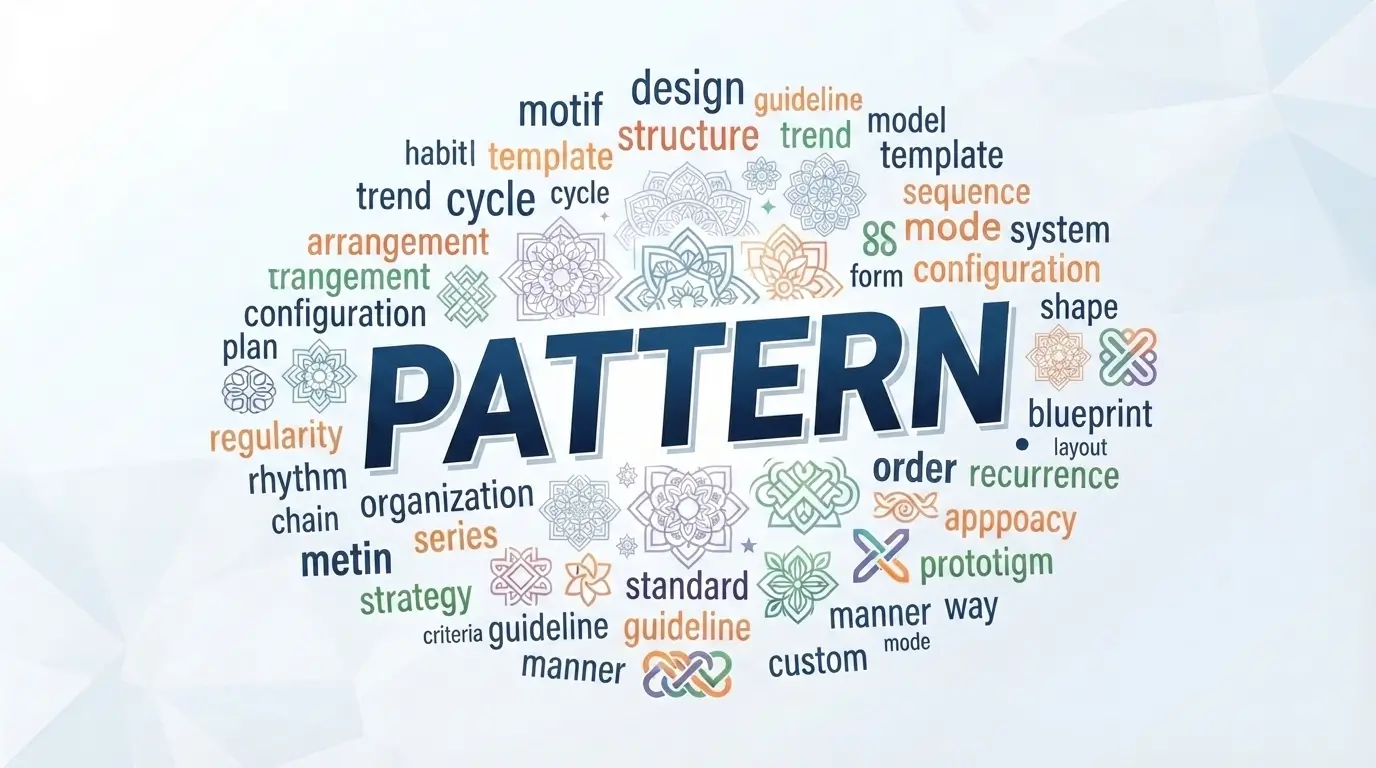
Synonyms of pattern become useful when you want to describe repeated designs, behaviors, or events without using the same word again.
Imagine noticing the same mistake every week. You might call it a pattern, habit, tendency, or recurring behavior.
Learning synonyms of pattern helps students choose precise words. It also makes essays, blogs, emails, and everyday conversations more natural.
For bloggers and content writers, synonyms of pattern reduce repetition. They also help explain whether you mean a design, trend, structure, or repeated action.
What Does “Pattern” Really Mean?
A pattern is a repeated design, arrangement, behavior, event, or structure that can be recognized.
The word is most commonly used as a noun.
For example:
“I noticed a pattern in his behavior.”
Here, pattern means a repeated way of behaving.
In another sentence:
“The dress has a beautiful floral pattern.”
Here, pattern means a decorative design.
The word is common in everyday English and appears in many fields, including:
- Art
- Fashion
- Mathematics
- Science
- Writing
- Psychology
- Business
- Technology
- Data analysis
- Education
The best synonym depends on the meaning you want to express.
Connotative Meaning of “Pattern”
Connotation means the feeling or idea a word suggests beyond its basic meaning.
Positive Tone
Pattern can suggest order, beauty, consistency, or organization.
Example:
“The designer created a beautiful pattern.”
Neutral Tone
Pattern is often completely neutral.
Example:
“The researchers found a pattern in the results.”
Negative Tone
Pattern can describe repeated unwanted behavior.
Example:
“This pattern of mistakes needs to stop.”
Etymology of “Pattern”
The word pattern developed through Middle English and is connected historically with French patron, meaning a model, example, or guide.
The deeper origin goes back to Latin patronus, meaning “protector” or “master.”
Old English: 450–1100
The modern word pattern was not used in its current form during Old English. English had other words for ideas such as example, model, form, and arrangement.
Middle English: 1100–1500
After the Norman French influence, words related to patron entered English. The meaning gradually moved toward the idea of a model or example.
Modern English: 1500–Present
The meaning expanded to include repeated designs, regular behavior, recurring events, and recognizable structures.
Today, pattern is used across everyday, academic, creative, and professional English.
Pronunciation of “Pattern”
US: /ˈpætərn/
UK: /ˈpætən/
Syllables
pat-tern
Affixation Pattern
Root: pattern
Prefix: None
Suffix: None in its modern English form
Synonyms of Pattern
Design
Design (noun) — US /dɪˈzaɪn/ | UK /dɪˈzaɪn/
Meaning: A design is a planned arrangement of visual or structural elements.
Examples:
- I love the design on this shirt.
- The website has a clean design.
Motif
Motif (noun) — US /moʊˈtiːf/ | UK /məʊˈtiːf/
Meaning: A motif is a repeated artistic, visual, or thematic element.
Examples:
- Birds are a common motif in her paintings.
- The novel uses a water motif.
Model
Model (noun) — US /ˈmɑːdəl/ | UK /ˈmɒdəl/
Meaning: A model is an example or structure that can serve as a guide.
Examples:
- The teacher gave us a model answer.
- This building became a model for future designs.
Template
Template (noun) — US /ˈtemplət/ | UK /ˈtemplət/
Meaning: A template is a reusable format or structure.
Examples:
- I used a template for my essay.
- The company created an email template.
Structure
Structure (noun) — US /ˈstrʌktʃər/ | UK /ˈstrʌktʃə/
Meaning: Structure is the way different parts are organized.
Examples:
- The article has a clear structure.
- We studied the structure of the sentence.
Framework
Framework (noun) — US /ˈfreɪmwɜːrk/ | UK /ˈfreɪmwɜːk/
Meaning: A framework is an organized structure supporting an idea or process.
Examples:
- The course provides a useful framework.
- We need a framework for the project.
Arrangement
Arrangement (noun) — US /əˈreɪndʒmənt/ | UK /əˈreɪndʒmənt/
Meaning: An arrangement is the way things are organized or positioned.
Examples:
- The flower arrangement looks beautiful.
- I like the arrangement of the furniture.
Form
Form (noun) — US /fɔːrm/ | UK /fɔːm/
Meaning: Form is the shape, appearance, or organization of something.
Examples:
- The poem has an unusual form.
- The building has a simple form.
Configuration
Configuration (noun) — US /kənˌfɪɡjəˈreɪʃən/ | UK /kənˌfɪɡjəˈreɪʃən/
Meaning: Configuration means the particular arrangement of parts.
Examples:
- The computer has a powerful configuration.
- We changed the seating configuration.
Layout
Layout (noun) — US /ˈleɪaʊt/ | UK /ˈleɪaʊt/
Meaning: Layout is the way visual elements are positioned.
Examples:
- The page has a simple layout.
- I changed the layout of the room.
Format
Format (noun) — US /ˈfɔːrmæt/ | UK /ˈfɔːmæt/
Meaning: Format is the particular arrangement or presentation of something.
Examples:
- The article follows a simple format.
- Which file format do you need?
Scheme
Scheme (noun) — US /skiːm/ | UK /skiːm/
Meaning: A scheme is an organized plan or arrangement.
Examples:
- The colors follow a simple scheme.
- The project uses a clear organizational scheme.
Blueprint
Blueprint (noun) — US /ˈbluːprɪnt/ | UK /ˈbluːprɪnt/
Meaning: A blueprint is a detailed plan or model.
Examples:
- The architect prepared a blueprint.
- The plan became a blueprint for future projects.
Plan
Plan (noun) — US /plæn/ | UK /plæn/
Meaning: A plan is an intended way of organizing or completing something.
Examples:
- We need a clear plan.
- The team followed the original plan.
Sequence
Sequence (noun) — US /ˈsiːkwəns/ | UK /ˈsiːkwəns/
Meaning: A sequence is an ordered series of events or elements.
Examples:
- The events happened in sequence.
- Put the steps in the correct sequence.
Series
Series (noun) — US /ˈsɪəriːz/ | UK /ˈsɪəriːz/
Meaning: A series is a group of related things that occur one after another.
Examples:
- The artist created a series of paintings.
- We noticed a series of similar problems.
Cycle
Cycle (noun) — US /ˈsaɪkəl/ | UK /ˈsaɪkəl/
Meaning: A cycle is a sequence that repeats regularly.
Examples:
- The seasons follow a natural cycle.
- The machine runs through the same cycle.
Repetition
Repetition (noun) — US /ˌrepəˈtɪʃən/ | UK /ˌrepəˈtɪʃən/
Meaning: Repetition is something happening or appearing again.
Examples:
- Repetition helped me remember the words.
- The repetition creates a strong rhythm.
Recurrence
Recurrence (noun) — US /rɪˈkɜːrəns/ | UK /rɪˈkʌrəns/
Meaning: Recurrence means something happening again.
Examples:
- Researchers studied the recurrence of the problem.
- The recurrence surprised the team.
Regularity
Regularity (noun) — US /ˌreɡjəˈlerəti/ | UK /ˌreɡjəˈlærəti/
Meaning: Regularity means consistent repetition or order.
Examples:
- The train runs with regularity.
- The regularity of the results was interesting.
Routine
Routine (noun) — US /ruːˈtiːn/ | UK /ruːˈtiːn/
Meaning: A routine is a regular way of doing things.
Examples:
- My morning routine starts at seven.
- She follows the same routine every day.
Habit
Habit (noun) — US /ˈhæbɪt/ | UK /ˈhæbɪt/
Meaning: A habit is a repeated behavior that becomes usual.
Examples:
- Reading before bed is a good habit.
- He has a habit of checking his phone.
Tendency
Tendency (noun) — US /ˈtendənsi/ | UK /ˈtendənsi/
Meaning: A tendency is a usual way of behaving or developing.
Examples:
- She has a tendency to worry.
- The material has a tendency to shrink.
Trend
Trend (noun) — US /trend/ | UK /trend/
Meaning: A trend is a general direction in which something changes.
Examples:
- The data shows an upward trend.
- There is a growing trend toward online learning.
Progression
Progression (noun) — US /prəˈɡreʃən/ | UK /prəˈɡreʃən/
Meaning: Progression is movement through a series of stages.
Examples:
- The course follows a logical progression.
- We tracked the progression of the project.
Rhythm
Rhythm (noun) — US /ˈrɪðəm/ | UK /ˈrɪðəm/
Meaning: Rhythm is a repeated pattern of movement, sound, or events.
Examples:
- The song has a strong rhythm.
- The waves created a natural rhythm.
Order
Order (noun) — US /ˈɔːrdər/ | UK /ˈɔːdə/
Meaning: Order is an organized or logical arrangement.
Examples:
- Put the books in alphabetical order.
- The information appears in order.
Method
Method (noun) — US /ˈmeθəd/ | UK /ˈmeθəd/
Meaning: A method is a particular way of doing something.
Examples:
- This method makes learning easier.
- The researcher used a reliable method.
System
System (noun) — US /ˈsɪstəm/ | UK /ˈsɪstəm/
Meaning: A system is a set of connected parts working together.
Examples:
- The school uses a new system.
- The system follows a predictable process.
Process
Process (noun) — US /ˈprɑːses/ | UK /ˈprəʊses/
Meaning: A process is a series of actions or stages.
Examples:
- Learning is a gradual process.
- We improved the hiring process.
Procedure
Procedure (noun) — US /prəˈsiːdʒər/ | UK /prəˈsiːdʒə/
Meaning: A procedure is an established way of doing something.
Examples:
- Follow the safety procedure.
- The office has a standard procedure.
Practice
Practice (noun) — US /ˈpræktɪs/ | UK /ˈpræktɪs/
Meaning: A practice is a usual or accepted way of doing something.
Examples:
- This is common practice in schools.
- Regular writing is useful practice.
Behavior
Behavior (noun) — US /bɪˈheɪvjər/ | UK /bɪˈheɪvjə/
Meaning: Behavior is the way a person or group usually acts.
Examples:
- His behavior changed suddenly.
- Researchers studied animal behavior.
Convention
Convention (noun) — US /kənˈvenʃən/ | UK /kənˈvenʃən/
Meaning: A convention is an accepted or traditional way of doing something.
Examples:
- The writer followed literary conventions.
- This is a common convention in formal writing.
Custom
Custom (noun) — US /ˈkʌstəm/ | UK /ˈkʌstəm/
Meaning: A custom is a traditional or usual practice.
Examples:
- Giving gifts is a common custom.
- The festival follows an old custom.
Tradition
Tradition (noun) — US /trəˈdɪʃən/ | UK /trəˈdɪʃən/
Meaning: A tradition is a practice passed from one generation to another.
Examples:
- Family dinners are an important tradition.
- The celebration follows a local tradition.
Synonyms of Pattern by Tone
Positive
These words can suggest order, creativity, or usefulness:
- Design
- Structure
- Framework
- Model
- Style
- Rhythm
- Arrangement
Neutral
These usually describe repetition or organization without strong emotion:
- Pattern
- Sequence
- Series
- Form
- Format
- System
- Process
- Method
- Regularity
- Progression
Negative
These can describe unwanted repeated behavior when used in the right context:
- Habit
- Tendency
- Recurrence
- Repetition
- Behavior
Creative or Informal
These are especially useful in artistic or everyday contexts:
- Motif
- Design
- Style
- Rhythm
- Form
- Layout
Tone matters because two similar words can create different impressions. Motif sounds artistic, trend sounds analytical, and habit often sounds personal.
Pattern vs Close Alternatives
Pattern vs Design
A pattern often involves repetition.
A design is broader. It can be a complete visual or functional plan.
“The fabric has a floral pattern.”
“The designer created a new dress design.”
Pattern vs Trend
A pattern describes something repeated or recognizable.
A trend describes a general direction of change.
“The data reveals a pattern.”
“The data shows an upward trend.”
Pattern vs Habit
A habit normally describes repeated behavior.
A pattern can describe behavior, design, data, events, or structure.
“Checking email every morning is a habit.”
“The researchers noticed a pattern in the results.”
How Pattern Changes by Context
Daily Conversation
In everyday speech, pattern often refers to repeated behavior.
“I’m starting to see a pattern.”
This expression is natural when someone notices that similar things keep happening.
Writing and Blogging
Writers may use pattern, structure, format, or style depending on what they are describing.
For example:
“The article follows a clear structure.”
This is better than using pattern if you specifically mean how the article is organized.
Professional and Academic English
In research, pattern is often used for recurring findings.
Common phrases include:
- pattern in the data
- pattern of behavior
- language pattern
- seasonal pattern
- recurring pattern
More precise alternatives such as trend, sequence, or recurrence may be useful when appropriate.
Creative Writing
In literature, motif is often a better choice when a symbol, image, or idea appears repeatedly.
For example:
“The writer uses darkness as a recurring motif.”
Common Mistakes Learners Make
Mistake 1: Using “trend” for every pattern
A trend usually describes movement or development.
A repeated design is not necessarily a trend.
Mistake 2: Using “habit” for objects
A person can have a habit.
A shirt has a pattern, not a habit.
Mistake 3: Using “motif” in every situation
Motif is strongly connected with art, literature, music, and design.
It can sound too formal in simple conversations.
Mistake 4: Assuming every synonym is interchangeable
Synonyms usually share a core meaning, but their exact meanings can differ.
Always consider the context.
Mistake 5: Overusing one synonym
Replacing every instance of pattern with another word can make writing unnatural.
Use a synonym only when it adds clarity or avoids unnecessary repetition.
Real-Life Examples of Pattern
Workplace
A manager notices that several reports arrive late every Friday.
She might say:
“There seems to be a pattern in the submission times.”
Social Situation
A friend repeatedly cancels plans.
You might say:
“This is becoming a pattern.”
Media and Pop Culture
A filmmaker repeatedly uses mirrors throughout a movie.
A reviewer may call the mirror a recurring motif.
Writing
A writer repeatedly begins paragraphs with questions.
This can be described as a writing pattern or style.
Why Learning Synonyms of Pattern Matters
Knowing synonyms is not just about making your vocabulary bigger.
It helps you communicate exact ideas.
For example, trend tells readers that something is moving in a particular direction. Habit points to repeated behavior. motif points to a recurring artistic element.
This difference matters in academic writing, blog posts, essays, emails, and everyday conversations.
Good vocabulary also reduces unnecessary repetition.
Instead of writing:
“The pattern appears in the pattern of behavior.”
You can write:
“The same tendency appears in his behavior.”
The second sentence is clearer and more natural.
Practice Exercise
Choose the best word for each sentence.
1. The researchers discovered a repeated ______ in the data.
A. habit
B. pattern
C. tradition
D. style
2. Checking your email every morning can become a ______.
A. motif
B. habit
C. design
D. format
3. The artist uses flowers as a recurring ______.
A. motif
B. procedure
C. method
D. system
4. The report shows a growing ______ toward remote work.
A. trend
B. habit
C. arrangement
D. form
5. The essay has a clear ______.
A. structure
B. custom
C. recurrence
D. rhythm
6. Put these events in the correct ______.
A. sequence
B. behavior
C. tendency
D. design
7. The company uses a standard ______ for its reports.
A. template
B. motif
C. habit
D. trend
8. The seasons follow a natural ______.
A. cycle
B. style
C. format
D. model
9. This is a common ______ in academic writing.
A. practice
B. layout
C. blueprint
D. design
10. The website has a clean and simple ______.
A. layout
B. tendency
C. recurrence
D. custom
11. The course provides a useful ______ for understanding the topic.
A. framework
B. habit
C. motif
D. tradition
12. Researchers studied the ______ of similar events.
A. recurrence
B. style
C. template
D. plan
Answer Key
1-B | 2-B | 3-A | 4-A | 5-A | 6-A | 7-A | 8-A | 9-A | 10-A | 11-A | 12-A
Reflection Task
Choose any three synonyms from this article and write one original sentence for each. Try using them in different contexts, such as school, work, or everyday conversation.
Conclusion
Synonyms of pattern give you more ways to describe repeated designs, behaviors, structures, and events with greater precision.
Learning words such as design, motif, trend, habit, structure, sequence, and framework can make your English more flexible and natural.
For students and writers, these alternatives reduce repetition. For speakers, they make explanations clearer and help communicate subtle differences in meaning.
The best way to remember synonyms of pattern is to use them. Practice one new word today in an email, essay, blog paragraph, or daily conversation.
Evelyn Hartwell is an English vocabulary writer who focuses on clear, practical language for learners and everyday readers. Her writing explores synonyms, word meanings, pronunciation, tone, and natural usage. She believes that learning vocabulary should be simple, useful, and enjoyable. Her articles are designed to help students, bloggers, and English learners choose the right words with greater confidence.