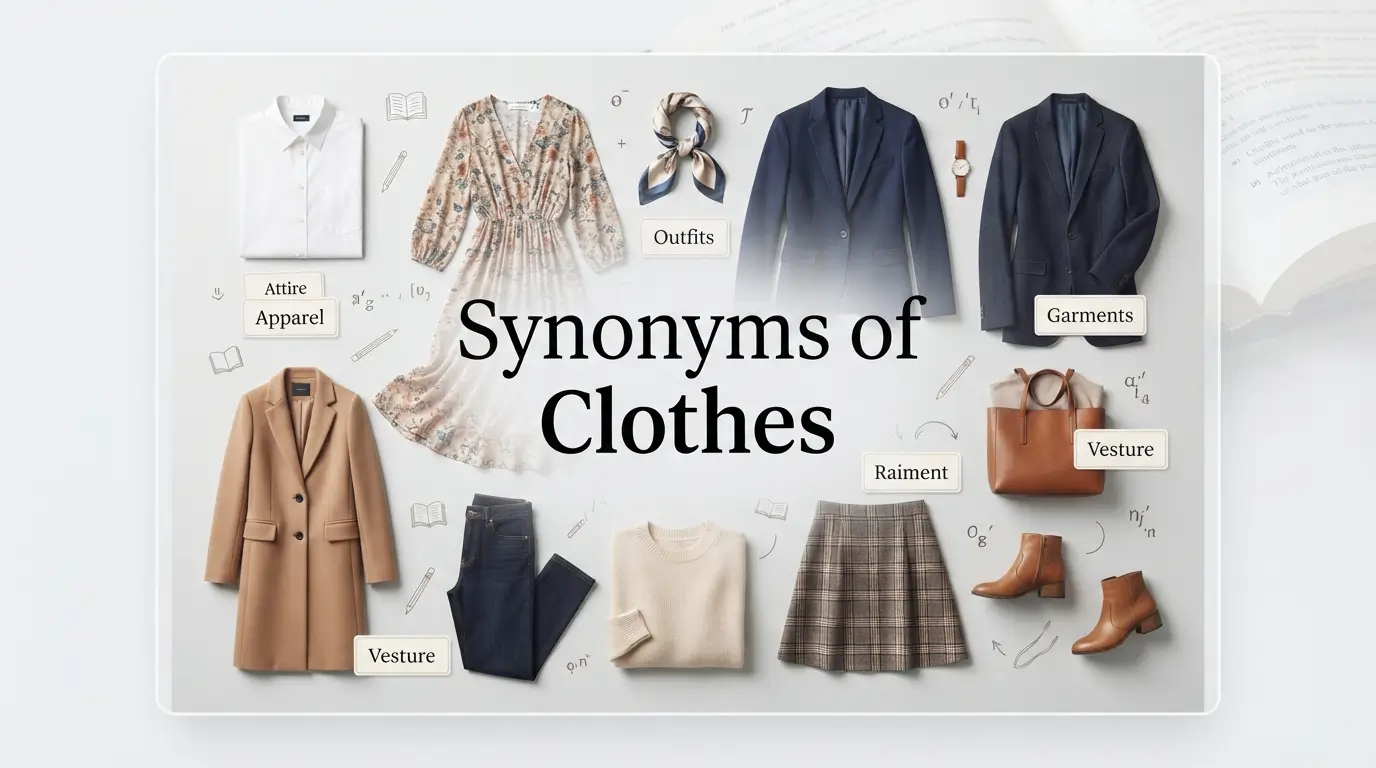
Synonyms of clothes can make your English more varied when you want to describe what people wear without repeating the same word.
Imagine preparing for a wedding and saying, “I need new clothes.” You could also say, “I need a new outfit.”
Learning synonyms of clothes helps you choose words based on style, purpose, setting, and level of formality.
Among English learners, these alternatives can improve vocabulary. Writers and everyday speakers can also use them to describe fashion more naturally.
What Does “Clothes” Really Mean?
Clothes means things that people wear on their bodies.
It is a plural noun. The word can describe shirts, trousers, dresses, jackets, coats, skirts, and many other wearable items.
Simple Definition
Clothes are things people wear to cover, protect, decorate, or keep their bodies comfortable.
Native speakers use clothes frequently because it is simple and natural in everyday English.
Examples
- I need some new clothes.
- Your clothes look great.
- Please put your clothes away.
- Her clothes were suitable for the weather.
The word works well in casual conversations, school assignments, blogs, stories, and general communication.
Connotative Meaning of “Clothes”
Connotation means the feeling, idea, or impression that a word suggests beyond its basic meaning.
Positive Tone
Words such as attire, ensemble, and outfit can suggest elegance, fashion, or careful styling.
Negative or Humorous Tone
Words such as duds and getup can sometimes sound funny, casual, or slightly critical.
Neutral Tone
Clothes, clothing, garments, and wear usually have a neutral tone.
Choosing the right alternative helps you express not only the meaning but also the mood of your sentence.
Etymology of “Clothes”
The modern word clothes developed from Old English clāþ, which meant cloth or woven material.
Over centuries, its meaning moved from the material itself toward things made from that material and eventually to items worn on the body.
Old English: 450–1100
The Old English word clāþ referred to cloth, fabric, or woven material.
Middle English: 1100–1500
During Middle English, forms related to cloth and clothes became more established. The meaning became increasingly connected with things worn by people.
Modern English: 1500–Present
Today, clothes is the normal plural noun used for things people wear.
The related word clothing is broader and often appears in formal or informational writing.
Pronunciation of “Clothes”
US: /kloʊðz/
UK: /kləʊðz/
Syllables
clothes
The word has one syllable.
Affixation Pattern
Root: cloth
Prefix: None
Suffix: Historical plural formation
45 Synonyms and Related Words for Clothes
Important: Not every word below is a perfect one-to-one synonym. Some are close alternatives, informal expressions, or words for particular categories of clothing. Native speakers choose them according to context.
Clothing
Clothing (noun) — US: /ˈkloʊðɪŋ/ | UK: /ˈkləʊðɪŋ/
Meaning: Clothing refers to things worn on the body.
Examples:
- She packed warm clothing for the journey.
- Protective clothing can help workers stay safe.
Usage: Neutral and slightly more formal than clothes.
Garments
Garments (noun) — US: /ˈɡɑːrmənts/ | UK: /ˈɡɑːmənts/
Meaning: Garments are individual pieces of clothing.
Examples:
- The designer creates handmade garments.
- Delicate garments need careful washing.
Usage: Common in fashion, textile, and formal contexts.
Apparel
Apparel (noun) — US: /əˈpærəl/ | UK: /əˈpærəl/
Meaning: Apparel refers to clothing as a general category.
Examples:
- The company produces sports apparel.
- Winter apparel should provide enough warmth.
Usage: More formal and common in fashion or business writing.
Attire
Attire (noun) — US: /əˈtaɪər/ | UK: /əˈtaɪə/
Meaning: Attire means the clothes someone wears, especially for a particular occasion.
Examples:
- Formal attire is required at the ceremony.
- Her traditional attire looked elegant.
Usage: Formal and polished.
Dress
Dress (noun) — US: /drɛs/ | UK: /dres/
Meaning: Dress can refer to clothing or a person’s overall style of clothing.
Examples:
- The invitation includes a dress code.
- His dress was appropriate for the event.
Usage: Common in expressions such as dress code and style of dress.
Outfit
Outfit (noun) — US: /ˈaʊtfɪt/ | UK: /ˈaʊtfɪt/
Meaning: An outfit is a set of clothes worn together.
Examples:
- I love your new outfit.
- She chose a comfortable outfit for dinner.
Usage: Very common in everyday English.
Wear
Wear (noun) — US: /wer/ | UK: /weə/
Meaning: Wear can refer to clothing designed for a particular purpose.
Examples:
- The shop sells outdoor wear.
- Sportswear is useful during exercise.
Usage: Often appears in compound words such as sportswear and outerwear.
Wardrobe
Wardrobe (noun) — US: /ˈwɔːrdroʊb/ | UK: /ˈwɔːdrəʊb/
Meaning: A wardrobe is a person’s collection of clothes.
Examples:
- She updated her winter wardrobe.
- His wardrobe contains several jackets.
Usage: Usually describes a collection rather than one item.
Ensemble
Ensemble (noun) — US: /ɑːnˈsɑːmbəl/ | UK: /ɒnˈsɒmbəl/
Meaning: An ensemble is a coordinated set of clothes.
Examples:
- Her evening ensemble looked elegant.
- He chose a simple ensemble for the event.
Usage: Stylish and somewhat formal.
Garb
Garb (noun) — US: /ɡɑːrb/ | UK: /ɡɑːb/
Meaning: Garb means clothing associated with a particular group, culture, role, or period.
Examples:
- The actors wore medieval garb.
- The dancers appeared in traditional garb.
Usage: Common in historical and cultural descriptions.
Raiment
Raiment (noun) — US: /ˈreɪmənt/ | UK: /ˈreɪmənt/
Meaning: Raiment is an old-fashioned word meaning clothing.
Examples:
- The story describes colorful raiment.
- The character wore simple raiment.
Usage: Literary and uncommon in modern conversation.
Vesture
Vesture (noun) — US: /ˈvɛstʃər/ | UK: /ˈvɛstʃə/
Meaning: Vesture is a formal or literary word for clothing.
Examples:
- The painting shows royal vesture.
- The character appeared in ceremonial vesture.
Usage: Rare and mainly literary or historical.
Habiliment
Habiliment (noun) — US: /həˈbɪləmənt/ | UK: /həˈbɪlɪmənt/
Meaning: Habiliment means clothing, especially in formal or historical language.
Examples:
- The painting shows elaborate habiliments.
- The characters wore ceremonial habiliments.
Usage: Rare and literary.
Vestments
Vestments (noun) — US: /ˈvɛstmənts/ | UK: /ˈvɛstmənts/
Meaning: Vestments are special clothes worn during religious ceremonies.
Examples:
- The priest wore ceremonial vestments.
- The museum displayed historic vestments.
Usage: A specialized term rather than a general word for clothes.
Costume
Costume (noun) — US: /ˈkɑːstuːm/ | UK: /ˈkɒstjuːm/
Meaning: A costume is clothing worn for a character, performance, celebration, or theme.
Examples:
- She wore a costume for the school play.
- The actors changed costumes backstage.
Usage: Usually not used for ordinary daily clothing.
Uniform
Uniform (noun) — US: /ˈjuːnəfɔːrm/ | UK: /ˈjuːnɪfɔːm/
Meaning: A uniform is standard clothing worn by members of a group.
Examples:
- Students wear a school uniform.
- His work uniform was clean.
Usage: Common for schools, workplaces, teams, and organizations.
Gear
Gear (noun) — US: /ɡɪr/ | UK: /ɡɪə/
Meaning: Gear can mean clothing and equipment used for an activity.
Examples:
- Bring warm hiking gear.
- His winter gear kept him comfortable.
Usage: Informal and often connected with activities.
Threads
Threads (noun) — US: /θrɛdz/ | UK: /θredz/
Meaning: Threads is informal slang for clothes.
Examples:
- He bought some new threads.
- Those threads look stylish.
Usage: Casual and playful.
Duds
Duds (noun) — US: /dʌdz/ | UK: /dʌdz/
Meaning: Duds is an informal word for clothes.
Examples:
- I need some clean duds.
- He packed extra duds for the trip.
Usage: Casual and sometimes humorous.
Togs
Togs (noun) — US: /tɑːɡz/ | UK: /tɒɡz/
Meaning: Togs is an informal word for clothes.
Examples:
- Pack your swimming togs.
- He changed into comfortable togs.
Usage: Informal and more common in some varieties of English.
Getup
Getup (noun) — US: /ˈɡɛtʌp/ | UK: /ˈɡetʌp/
Meaning: A getup is a particular set or style of clothing.
Examples:
- That is an unusual getup.
- Her stage getup was colorful.
Usage: Informal and sometimes humorous.
Kit
Kit (noun) — US: /kɪt/ | UK: /kɪt/
Meaning: Kit can refer to clothing used for sports or a particular activity.
Examples:
- The players wore their new kit.
- I packed my cycling kit.
Usage: Especially common in British English for sports clothing.
Dresswear
Dresswear (noun) — US: /ˈdreswer/ | UK: /ˈdresweə/
Meaning: Dresswear refers to clothing intended for formal or special occasions.
Examples:
- The event requires formal dresswear.
- She selected elegant dresswear.
Usage: Less common than formalwear or formal attire.
Formalwear
Formalwear (noun) — US: /ˈfɔːrməlwer/ | UK: /ˈfɔːməlweə/
Meaning: Formalwear means clothing worn for formal occasions.
Examples:
- He chose formalwear for the wedding.
- Formalwear is suitable for the ceremony.
Usage: Clear and specific.
Sportswear
Sportswear (noun) — US: /ˈspɔːrtswer/ | UK: /ˈspɔːtsweə/
Meaning: Sportswear means clothing designed for sports or exercise.
Examples:
- She prefers comfortable sportswear.
- The players wore matching sportswear.
Usage: A specialized clothing term.
Activewear
Activewear (noun) — US: /ˈæktɪvwer/ | UK: /ˈæktɪvweə/
Meaning: Activewear means clothing designed for exercise and active movement.
Examples:
- She wore activewear during her workout.
- Comfortable activewear is useful for training.
Usage: Common in modern fitness and fashion language.
Outerwear
Outerwear (noun) — US: /ˈaʊtərwer/ | UK: /ˈaʊtəweə/
Meaning: Outerwear means clothing worn over other clothes.
Examples:
- Bring warm outerwear for winter.
- Her outerwear was waterproof.
Usage: Usually includes coats and jackets.
Underwear
Underwear (noun) — US: /ˈʌndərwer/ | UK: /ˈʌndəweə/
Meaning: Underwear means clothes worn underneath outer clothing.
Examples:
- Pack enough underwear for the trip.
- Cotton underwear can feel comfortable.
Usage: A specific clothing category.
Nightwear
Nightwear (noun) — US: /ˈnaɪtwer/ | UK: /ˈnaɪtweə/
Meaning: Nightwear means clothing worn for sleeping.
Examples:
- She packed warm nightwear.
- The children changed into nightwear.
Usage: Common in British English and formal descriptions.
Sleepwear
Sleepwear (noun) — US: /ˈsliːpwer/ | UK: /ˈsliːpweə/
Meaning: Sleepwear means clothes worn while sleeping.
Examples:
- She bought comfortable sleepwear.
- The children changed into sleepwear.
Usage: Neutral and widely understood.
Workwear
Workwear (noun) — US: /ˈwɜːrkwer/ | UK: /ˈwɜːkweə/
Meaning: Workwear means clothing designed for work.
Examples:
- The workers wore protective workwear.
- Durable workwear is useful outdoors.
Usage: Common for occupational clothing.
Casualwear
Casualwear (noun) — US: /ˈkæʒuəlwer/ | UK: /ˈkæʒuəlweə/
Meaning: Casualwear means relaxed clothing for informal situations.
Examples:
- Jeans are common casualwear.
- The event allows casualwear.
Usage: Common in fashion discussions.
Beachwear
Beachwear (noun) — US: /ˈbiːtʃwer/ | UK: /ˈbiːtʃweə/
Meaning: Beachwear means clothing intended for beach activities.
Examples:
- She packed light beachwear.
- Colorful beachwear is popular in summer.
Usage: A specific clothing category.
Swimwear
Swimwear (noun) — US: /ˈswɪmwer/ | UK: /ˈswɪmweə/
Meaning: Swimwear means clothing designed for swimming.
Examples:
- Remember to pack your swimwear.
- The swimmers wore matching swimwear.
Usage: Specific and neutral.
Streetwear
Streetwear (noun) — US: /ˈstriːtwer/ | UK: /ˈstriːtweə/
Meaning: Streetwear is casual fashion influenced by urban culture.
Examples:
- Streetwear often includes sneakers.
- His style mixes streetwear with classic pieces.
Usage: Common in modern fashion discussions.
Menswear
Menswear (noun) — US: /ˈmenzwer/ | UK: /ˈmenzweə/
Meaning: Menswear means clothing designed or marketed for men.
Examples:
- The store has a large menswear section.
- He follows modern menswear trends.
Usage: Common in fashion writing.
Womenswear
Womenswear (noun) — US: /ˈwɪmənzwer/ | UK: /ˈwɪmənzweə/
Meaning: Womenswear means clothing designed or marketed for women.
Examples:
- The company specializes in womenswear.
- She follows current womenswear trends.
Usage: Common in fashion and clothing discussions.
Childrenswear
Childrenswear (noun) — US: /ˈtʃɪldrənzwer/ | UK: /ˈtʃɪldrənzweə/
Meaning: Childrenswear means clothing designed for children.
Examples:
- The store sells childrenswear.
- Comfortable childrenswear is useful for active children.
Usage: Mostly used in fashion and clothing contexts.
Footwear
Footwear (noun) — US: /ˈfʊtwer/ | UK: /ˈfʊtweə/
Meaning: Footwear means items worn on the feet.
Examples:
- Comfortable footwear is important for hiking.
- The shop offers different types of footwear.
Usage: Refers specifically to shoes, boots, sandals, and similar items.
Fashions
Fashions (noun) — US: /ˈfæʃənz/ | UK: /ˈfæʃənz/
Meaning: Fashions refers to popular styles of clothing and appearance.
Examples:
- Fashions change over time.
- The magazine discusses modern fashions.
Usage: Better for discussing styles and trends than ordinary clothes.
Synonyms of Clothes by Tone
Neutral Words
These words work well in everyday or general writing:
- Clothes
- Clothing
- Garments
- Apparel
- Outfit
- Wear
- Dress
- Wardrobe
Formal Words
These choices sound more polished:
- Attire
- Apparel
- Garments
- Ensemble
- Formalwear
- Vestments
- Vesture
Informal Words
These fit relaxed conversation:
- Threads
- Duds
- Togs
- Getup
- Gear
- Kit
Specialized Words
These describe particular categories:
- Uniform
- Costume
- Sportswear
- Activewear
- Outerwear
- Underwear
- Nightwear
- Sleepwear
- Workwear
- Beachwear
- Swimwear
- Streetwear
- Footwear
Tone matters because the best word depends on your audience, purpose, and situation.
“Clothes” vs Close Alternatives
Clothes vs Clothing
In everyday speech clothes is more common.
“I need some new clothes.”
Clothing sounds more general and slightly more formal.
“Protective clothing is required.”
Clothes vs Outfit
Clothes can mean clothing in general.
Outfit usually means a complete combination of clothes.
“She bought new clothes.”
“She wore a beautiful outfit.”
Clothes vs Attire
Clothes has a neutral tone.
Attire often sounds formal and refers to clothing suitable for a particular occasion.
“Bring comfortable clothes.”
“Formal attire is required.”
Clothes vs Wardrobe
Clothes can describe individual items or clothing generally.
Wardrobe means a collection of clothes.
“These clothes are new.”
“She has a large wardrobe.”
How “Clothes” Changes by Context
Daily Conversation
In everyday speech, clothes, outfit, wear, and wardrobe sound natural.
“I need warm clothes for winter.”
“Your outfit looks great.”
Writing and Blogging
Bloggers can use clothing, attire, apparel, and garments to reduce unnecessary repetition.
For example, an article can mention summer clothing, describe a specific outfit, and then discuss suitable attire for a special event.
Professional and Academic English
Professional writing often uses clothing, garments, apparel, uniform, and attire.
“Protective clothing can reduce workplace risks.”
These words usually sound more appropriate than informal slang.
Creative and Informal English
Creative writing can use garb, threads, getup, or ensemble to create a particular mood.
“He arrived in flashy threads and immediately attracted attention.”
The word threads gives the sentence a relaxed and playful feeling.
Common Mistakes and Native Usage
Mistake 1: Using “Clothes” as a Singular Noun
Incorrect:
“I bought a clothes.”
Correct:
“I bought some clothes.”
For one item, use a specific noun.
“I bought a shirt.”
Mistake 2: Confusing “Cloth” and “Clothes”
Cloth means fabric or material.
Clothes means things people wear.
“This cloth feels soft.”
“These clothes feel comfortable.”
Mistake 3: Using “Clothing” Incorrectly
Avoid:
“I bought a clothing.”
Better:
“I bought some clothes.”
Or:
“I bought a piece of clothing.”
Mistake 4: Using Slang in Formal Writing
Words such as threads, duds, and getup are casual.
Academic essays usually sound better with clothing, garments, or attire.
Mistake 5: Treating Every Word as an Exact Synonym
The 45 terms above are not all interchangeable.
For example:
- Wardrobe = a collection of clothes
- Outfit = a coordinated set
- Uniform = standardized clothing
- Costume = special or character clothing
- Footwear = items worn on the feet
- Sportswear = clothing for sports
- Swimwear = clothing for swimming
Knowing these differences makes your English more accurate.
Register Notes
Everyday English: Clothes, clothing, outfit
Formal English: Attire, apparel, garments
Fashion vocabulary: Ensemble, apparel, fashions
Informal English: Threads, duds, getup
Sports vocabulary: Sportswear, kit, activewear
Work vocabulary: Workwear, uniform
Sleep vocabulary: Nightwear, sleepwear
Beach vocabulary: Beachwear, swimwear
Historical vocabulary: Garb, raiment, vesture
Foot-related vocabulary: Footwear
A strong vocabulary does not mean choosing the most complicated word. It means selecting the word that fits the situation.
Real-Life Mini Scenarios
Workplace
A manager might say:
“Please wear appropriate attire for the conference.”
A colleague may use simpler language:
“Your outfit looks professional.”
Social Situation
A friend might say:
“I need new clothes for the party.”
Another friend could reply:
“That ensemble would look perfect.”
Media and Pop Culture
Fashion articles often use ensemble, attire, apparel, and streetwear.
A celebrity may be described as wearing a stylish ensemble at an event.
Storytelling
A historical story might describe a character wearing traditional garb.
A comedy might describe someone wearing a strange getup.
The selected synonym can change the mood of the entire description.
Why Learning Synonyms of Clothes Matters
Learning synonyms of clothes gives you more accurate ways to describe fashion, appearance, and different types of clothing.
It can also improve reading comprehension because books, blogs, magazines, and websites may use different words for similar ideas.
Among English learners, these alternatives can expand active vocabulary and make descriptions more precise.
For bloggers and content writers, varied clothing terms can make articles smoother and reduce unnecessary repetition.
Among students, precise vocabulary can make descriptive essays clearer and more engaging.
In everyday conversations, these words provide natural ways to discuss outfits, fashion, appearance, and personal style.
Instead of repeating:
“Her clothes were beautiful. Her clothes were colorful. Her clothes were stylish.”
You can write:
“Her outfit was beautiful. The ensemble was colorful, and her attire looked stylish.”
The second version sounds more varied and precise.
Practice Exercise: Synonyms of Clothes
Choose the best answer for each question.
1. You are talking casually about what you wear every day. Which word is most natural?
A. Vesture
B. Clothes
C. Habiliment
D. Raiment
2. Students must wear the same clothing at school. Which word fits best?
A. Uniform
B. Threads
C. Getup
D. Garb
3. Which word means a complete set of clothes worn together?
A. Wardrobe
B. Outfit
C. Apparel
D. Wear
4. Which word sounds most suitable for formal writing?
A. Duds
B. Threads
C. Attire
D. Togs
5. Which word means a person’s collection of clothes?
A. Wardrobe
B. Outfit
C. Garment
D. Costume
6. Which word is especially common for sports clothing in British English?
A. Kit
B. Raiment
C. Vesture
D. Habiliment
7. Which word can sound playful or humorous?
A. Clothing
B. Getup
C. Apparel
D. Garments
8. An actor wears special clothing for a movie character. Which word fits best?
A. Costume
B. Wardrobe
C. Wear
D. Clothes
9. Which word refers to an individual piece of clothing?
A. Ensemble
B. Wardrobe
C. Garment
D. Attire
10. Which word can mean clothing and equipment used for an activity?
A. Gear
B. Raiment
C. Vesture
D. Habiliment
11. Which word is informal slang for clothes?
A. Threads
B. Apparel
C. Garments
D. Attire
12. Which word describes special religious clothing?
A. Duds
B. Vestments
C. Threads
D. Togs
13. Which word can describe clothing associated with a culture or historical period?
A. Garb
B. Wardrobe
C. Outfit
D. Wear
14. Which sentence uses “clothing” correctly?
A. I bought a clothing yesterday.
B. Protective clothing can be useful outdoors.
C. She wore one clothing.
D. He has three clothings.
15. Which word is closest to “clothes” but sounds more formal?
A. Apparel
B. Duds
C. Threads
D. Getup
Reflection Task
Choose one synonym of clothes that you rarely use. Write your own sentence with it and explain why that word fits your situation.
Answer Key: 1. B | 2. A | 3. B | 4. C | 5. A | 6. A | 7. B | 8. A | 9. C | 10. A | 11. A | 12. B | 13. A | 14. B | 15. A
Conclusion
Learning synonyms of clothes gives you more accurate ways to describe fashion, appearance, style, and different types of clothing.
Words such as clothing, outfit, attire, garments, and apparel work well in different situations and writing styles.
Informal words like threads, duds, and getup can make casual English more expressive, while formal terms can strengthen essays and professional writing.
Choose three new words from this list and use them in your own sentences, emails, essays, or conversations. Regular practice will help make them part of your active vocabulary.

Evelyn Hartwell is an English vocabulary writer who focuses on clear, practical language for learners and everyday readers. Her writing explores synonyms, word meanings, pronunciation, tone, and natural usage. She believes that learning vocabulary should be simple, useful, and enjoyable. Her articles are designed to help students, bloggers, and English learners choose the right words with greater confidence.